

Your shopping cart is currently empty.
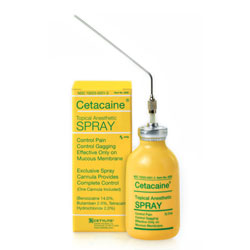
Cetacaine Topical Spray
Veterinarian Prescription (Rx) Required
Free Shipping on orders over $75Low Price Match Guarantee
- Prescription topical anesthetic for accessible mucous membranes except the eyes
- Contains benzocaine, butamben, and tetracaine hydrochloride
- Provides rapid-onset local anesthesia when used as directed
- For veterinarian-directed topical use during appropriate procedures
Price: $214.95
$193.46 -10% future orders
$193.46 -10% future orders
$193.46 -10% future orders
$193.46 -10% future orders
$193.46 -10% future orders
$193.46 -10% future orders
$193.46 -10% future orders
$193.46 -10% future orders
Licensed U.S. PharmacyReal pharmacists.
How to Order Prescriptions
Description
Cetacaine® Topical Anesthetic Spray is a prescription topical anesthetic containing benzocaine, butamben, and tetracaine hydrochloride. It is formulated to produce local anesthesia of accessible mucous membranes except the eyes.
Cetacaine Spray may be prescribed by a veterinarian for appropriate procedures where localized control of pain or gagging is needed. The spray acts rapidly when applied directly to the treatment area and should be administered only according to veterinarian directions.
Uses & Benefits
- Prescription topical anesthetic
- Produces local anesthesia of accessible mucous membranes
- Helps control pain during appropriate procedures
- Helps control gagging during appropriate procedures
- Rapid onset of topical anesthetic action
- Contains three topical anesthetic agents
- Applied directly to the site requiring local anesthesia
- Spray cannula allows controlled application
How It Works
Cetacaine® combines benzocaine, butamben, and tetracaine hydrochloride. These topical anesthetic agents reversibly block nerve conduction at the application site, temporarily reducing sensation in the treated mucous membrane.
The combination provides rapid onset with continued local anesthetic activity. When used according to labeling, anesthesia generally begins rapidly and typically lasts approximately 30 to 60 minutes.
Indications
Cetacaine® is indicated for producing anesthesia of accessible mucous membranes except the eyes. It may be used to control pain or gagging during appropriate procedures.
Ear / Nose / Mouth / Pharynx / Larynx / Trachea / Bronchi / Esophagus / Vaginal Procedures When Feasible / Rectal Procedures When Feasible / Surgical Procedures / Endoscopic Procedures
Use only as prescribed and directed by a licensed veterinarian.
Ingredients
Active Ingredients:
Benzocaine 14% / Butamben 2% / Tetracaine Hydrochloride 2%
Inactive Ingredients:
Dipropylene Glycol / Saccharin / Benzalkonium Chloride / Cetyl Dimethyl Ethyl Ammonium Bromide
Directions
Use only as prescribed and directed by your veterinarian.
Cetacaine® Spray should be applied for approximately 1 second or less for normal anesthesia.
Spraying for more than 2 seconds is contraindicated.
Each 1-second spray delivers an average of approximately 200 mg of product, excluding propellant.
To apply, firmly attach the appropriate cannula to the protruding plastic stem on the bottle. Press the cannula forward to activate the spray valve.
Apply directly to the site where local anesthesia is required. The tissue does not need to be dried before application.
The cannula may be removed for appropriate cleaning or sterilization and is autoclavable.
Follow the prescription instructions and veterinarian directions exactly. Do not exceed the prescribed amount or application time.
Cautions
- Prescription use only.
- Use only under the direction of a licensed veterinarian.
- For topical use only.
- Never administer by injection.
- Do not use in or around the eyes.
- Do not apply to large areas of denuded or inflamed tissue.
- Do not use in patients with known hypersensitivity to any ingredient.
- Do not use in patients known to have cholinesterase deficiencies.
- Do not use under dentures or cotton rolls.
- Do not exceed the recommended application amount.
- Keep out of reach of children and animals.
Possible Side Effects
Local Irritation / Hypersensitivity Reaction / Methemoglobinemia / Cyanosis / Dizziness or Weakness / Difficulty Breathing / Seizures / Cardiac Rhythm Abnormalities
Methemoglobinemia has been reported with local anesthetics, including benzocaine-containing products. Signs may occur immediately or several hours after exposure and can become serious. Seek immediate medical or veterinary attention if an unexpected or severe reaction occurs.
Precautions
Use the smallest amount necessary to produce the desired local anesthesia.
Cetacaine® should not be applied to large areas of denuded or inflamed tissue because excessive systemic absorption may occur.
Use additional caution in patients who may be more susceptible to methemoglobinemia or adverse effects from local anesthetics.
Tell your veterinarian about all medications, medical conditions, sensitivities, and previous reactions to local anesthetics before Cetacaine is used.
Use only for the patient and procedure for which it was prescribed.
Storage
Store at controlled room temperature, 68°F to 77°F (20°C to 25°C).
Keep the container securely stored and inaccessible to children and animals.
Disposal
Dispose of unused or expired Cetacaine® Topical Anesthetic Spray through an appropriate medication take-back or hazardous pharmaceutical waste program when available. Do not puncture, burn, or improperly dispose of the pressurized container. Follow applicable local requirements for disposal of aerosol medication containers. Keep discarded medication, cannulas, and packaging securely inaccessible to children and animals.