
Your shopping cart is currently empty.
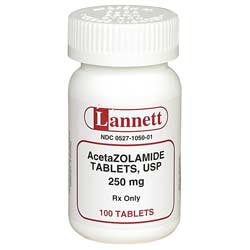
Acetazolamide Tablets
SKU : 3280_-RX

Price: $2.49
Save 20% on your first Autoship order
+ Save on each recurring order!
+ Save on each recurring order!
Veterinarian Prescription (RX) Required
Free Shipping on orders over $75
Low Price Match Guarantee
Free Shipping on orders over $75
Low Price Match Guarantee
- Diuretic commonly used in horses
- Also used to treat glaucoma
- Available Sizes
- 125mg: 100 count
- 250mg: single and 100 count
Brands may vary
How to Order Prescriptions
Description
Acetazolamide Tablets are used for adjunctive therapy of hyperkalemic periodic paralysis (HYPP) in horses and adjunctive treatment of metabolic alkalosis or glaucoma in dogs and cats.See your veterinarian for dosage information.
Key Benefits
- Easy-to-give tablet form
- Treatment for hyperkalemic periodic paralysis
- Diuretic that may also be used to treat glaucoma
- For dogs, cats and horses
How It Works
Acetazolamide Tablets are used to treat hyperkalemic periodic paralysis (HYPP) in horses. This type of periodic paralysis is characterized by hyperkalemia, or an increased level of potassium in the blood. As a diuretic agent, Acetazolamide Tablets work by ridding the body of excess fluid, along with certain minerals including potassium.
Indications
Acetazolamide has been used principally in veterinary medicine for its diuretic action and its effects on aqueous humor production in the treatment of glaucoma and metabolic alkalosis. It may be useful as an adjunctive treatment for syringomyelia in dogs. Acetazolamide's use in small animals is complicated by a relatively high occurrence of adverse effects.
In horses, acetazolamide is used as a preventive and/or treatment for HYPP.
In humans, the drug has been used as adjunctive therapy for epilepsy and for acute high-altitude sickness.
Low Price Guarantee
We will gladly match any competitors’ current advertised price.
Competitor must be based in the United States, sorry we cannot honor foreign country prices or sites that are membership priced.
Fast & Free Shipping
Orders Over $75 Qualify for FREE Ground Shipping (Excludes Items that Require Cooler or Express Delivery).
Satisfaction Guarantee
Every purchase you make at HeartlandVetSupply.com is covered by our satisfaction guarantee.
If you are not completely satisfied, please contact us within 30 days.
.Pharmacy


Heartland Veterinary Supply & Pharmacy is a .Pharmacy Accredited Pharmacy
Located in Hastings, Nebraska, Heartland Veterinary Supply & Pharmacy started as a Veterinary Clinic in 1981, specializing in the health and wellness of the equine, canine and feline species. We have a licensed Veterinarian and Pharmacist on site, as well as a helpful team with the knowledge and products you need to keep your horse, dog or cat healthy and happy. The Heartland Staff is dedicated to fast, courteous service.
"Because buying prescription drugs from the Internet is easy, finding a safe source for those medicines is not."

Contact us
- Phone: 800-934-9398
- Fax: 844-334-5653
- Email: [email protected]
- HeartlandVetSupply
- 401 W. 33rd Street
- Hastings, NE 68901
Customer Service
Topics
Connecticut, Delaware, New Hampshire, New Jersey, New York, Illinois