


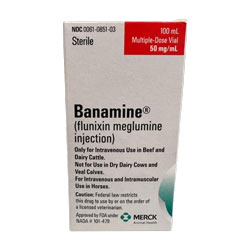
Banamine for Horses
- Veterinarian Prescription (Rx) Required
- Free Shipping on orders over $75
- Flunixin Meglumine
- For the alleviation of inflammation and pain associated with musculoskeletal disorders in the horse
| RX required for this item. Click here for our full Prescription Policy and Form |
by Merck Animal Health
Banamine® Injectable Solution
Pharmaceutical Name
Flunixin meglumine
Overview
Banamine brand of flunixin meglumine is the pioneer injectable non-steroidal anti-inflammatory drug approved for cattle and horses in the United States!
Banamine rapidly reduces the fever and lung inflammation that typically accompany bovine respiratory disease (BRD). With Banamine as part of a BRD treatment program, cattle feel better fast, and studies show they eat better sooner and have fewer lung lesions than cattle treated with conventional therapies.
Each milliliter of BANAMINE Injectable Solution contains flunixinmeglumine equivalent to 50 mg flunixin, 0.1 mg edetate disodium, 2.5 mg sodium formaldehyde sulfoxylate, 4.0 mg diethanolamine, 207.2mg propylene glycol; 5.0mg phenol as preservative, hydrochloric acid,water for injection qs
Safety
Horse:
A 3-fold intramuscular dose of 1.5 mg/lb of body weight daily for 10
consecutive days was safe. No changes were observed in hematology, serum
chemistry, or urinalysis values. Intravenous dosages of 0.5 mg/lb daily
for 15 days; 1.5 mg/lb daily for 10 days; and 2.5 mg/lb daily for 5
days produced no changes in blood or urine parameters. No injection site
irritation was observed following intramuscular injection of the 0.5
mg/lb recommended dose. Some irritation was observed following a 3-fold
dose administered intramuscularly.
Cattle: No
flunixin-related changes (adverse reactions) were noted in cattle
administered a 1X (2.2 mg/kg; 1.0 mg/lb) dose for 9 days (three times
the maximum clinical duration). Minimal toxicity manifested itself at
moderately elevated doses (3X and 5X) when flunixin was administered
daily for 9 days, with occasional findings of blood in the feces and/or
urine. Discontinue use if hematuria or fecal blood are observed.
http://msd-safetydatasheets.com/frame.asp - Search for #SP000351
Description
Each milliliter of BANAMINE Injectable Solution contains flunixin
meglumine equivalent to 50 mg flunixin, 0.1 mg edetate disodium, 2.5 mg
sodium formaldehyde sulfoxylate, 4.0 mg diethanolamine, 207.2 mg
propylene glycol; 5.0 mg phenol as preservative, hydrochloric acid,
water for injection q.s.
Indications
Horse:
BANAMINE Injectable Solution is recommended for the alleviation of
inflammation and pain associated with musculoskeletal disorders in the
horse. It is also recommended for the alleviation of visceral pain
associated with colic in the horse.
Cattle: BANAMINE Injectable Solution is indicated for the control of pyrexia associated with bovine respiratory disease, endotoxemia and acute bovine mastitis. BANAMINE Injectable Solution is also indicated for the control of inflammation in endotoxemia.
Administration and Dosage
Horse:
The recommended dose for musculoskeletal disorders is 0.5 mg per pound
(1 mL/100 lbs) of body weight once daily. Treatment may be given by
intravenous or intramuscular injection and repeated for up to 5 days.
Studies show onset of activity is within 2 hours. Peak response occurs
between 12 and 16 hours and duration of activity is 24-36 hours.
The recommended dose for the alleviation of pain associated with equine colic is 0.5 mg per pound of body weight. Intravenous administration is recommended for prompt relief. Clinical studies show pain is alleviated in less than 15 minutes in many cases. Treatment may be repeated when signs of colic recur. During clinical studies approximately 10% of the horses required one or two additional treatments. The cause of colic should be determined and treated with concomitant therapy.
Cattle: The recommended dose for cattle for control of pyrexia associated with bovine respiratory disease and endotoxemia and control of inflammation in endotoxemia is 1.1 to 2.2 mg/kg (0.5 to 1 mg/lb; 1 to 2 mL per 100 lbs) of body weight given by slow intravenous administration either once a day as a single dose or divided into two doses administered at 12-hour intervals for up to 3 days. The total daily dose should not exceed 2.2 mg/kg (1.0 mg/lb) of body weight. Avoid rapid intravenous administration of the drug.
The recommended dose for acute bovine mastitis is 2.2 mg/kg (1 mg/lb: 2 mL per 100 lbs) of body weight given once by intravenous administration.
Caution
As a class, cyclo-oxygenase inhibitory NSAID's may be associated with
gastrointestinal and renal toxicity. Sensitivity to drug-associated
adverse effects varies with the individual patient. Patients at greatest
risk for renal toxicity are those that are dehydrated, on concomitant
diuretic therapy, or those with renal, cardiovascular, and/or hepatic
dysfunction.
Since many NSAID's possess the potential to induce gastrointestinal ulceration, concomitant use of BANAMINE Injectable Solution with other anti-inflammatory drugs, such as other NSAIDs and corticosteroids, should be avoided or closely monitored.
Horse: The effect of BANAMINE Injectable Solution on pregnancy has not been determined. Studies to determine activity of BANAMINE Injectable Solution when administered concomitantly with other drugs have not been conducted. Drug compatibility should be monitored closely in patients requiring adjunctive therapy.
Cattle: Do not use in bulls intended for breeding, as reproductive effects of BANAMINE Injectable Solution in these classes of cattle have not been investigated. NSAIDs are known to have potential effects on both parturition and the estrous cycle. There may be a delay in the onset of estrus if flunixin is administered during the prostaglandin phase of the estrous cycle. The effects of flunixin on imminent parturition have not been evaluated in a controlled study. NSAIDs are known to have the potential to delay parturition through a tocolytic effect. Do not exceed the recommended dose.
Supply Information
BANAMINE Injectable Solution, 50 mg/mL is available in 50-mL (NDC
0061-0851-02), 100-mL (NDC 0061-0851-03), and 250-mL (NDC 0061-0851-04)
multi-dose vials.
Store between 2° and 30° C (36° and 86° F).
Contact information
US only:
Intervet/Schering-Plough Animal Health
livestocktechsrvc@sp.intervet.com
1-800-211-3574
Website
www.banamine.com
Product Label(s) and MSDS
Product Label
Banamine® Paste
Pharmaceutical NameFlunixin meglumine
Features and Benefits
- Quickly controls inflammatory responses.
- NSAID approved for oral administration.
- Non-narcotic; won't disrupt CNS or cardiac function.
- Non-steroidal; no adrenal suppression or steroid side effects.
- Active up to 36 hours.
Indications
BANAMINE® Paste is recommended for the alleviation of inflammation and pain associated with musculoskeletal disorders in the horse.
Dosage
For further information including dose rate and complete directions and warnings, please see the Product Label by clicking here.
Banamine® Paste is a registered trademark of Intervet/Schering-Plough Animal Health.
Product Label(s) and MSDS
DOSAGE AND ADMINISTRATION
The recommended dose of flunixin is 0.5 mg per lb of body weight once daily. The BANAMINE Paste syringe, calibrated in twelve 250-lb weight increments, delivers 125 mg of flunixin for each 250 lbs (see dosage table). One syringe will treat a 1000-lb horse once daily for 3 days, or three 1000-lb horses one time.
DOSAGE TABLE
|
Syringe Mark* |
Horse Weight (lbs) |
BANAMINE Paste Delivered (g) |
Mg Flunixin Delivered |
|
0 |
- |
- |
- |
|
250 |
250 |
2.5 |
125 |
|
500 |
500 |
5.0 |
250 |
|
750 |
750 |
7.5 |
375 |
|
1000 |
1000 |
10.0 |
500 |
*Use dial edge nearest syringe barrel to mark dose.
ACTIVITY
Flunixin meglumine is a potent nonnarcotic,
nonsteroidal, analgesic agent with anti-inflammatory and antipyretic
activity. It is significantly more potent than pentazocine, meperidine,
and codeine as an analgesic in the rat yeast paw test. Oral studies in
the horse show onset of flunixin activity occurs within 2 hours of
administration. Peak response occurs between 12 and 16 hours and
duration of activity is 24 to 36 hours.